Full Stack Everything
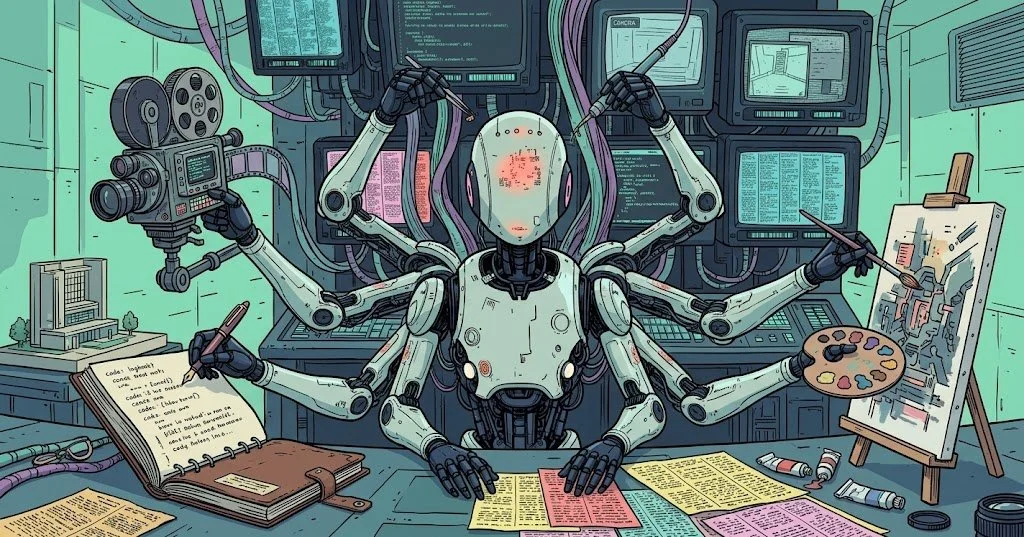
From coders to lawyers to content marketers, the pressure is on to become full stack.
The CTO at my current company has been vocal with his team recently. Our organization doesn’t have frontend engineers and backend engineers anymore. Everyone is full stack.
Haven’t literally worked at “Stack Overflow” this struck a chord. Since I entered the world of tech as a journalist in 2010, the demand for software engineers, along with their salaries and social status within the labor market, had only gone up.
The arrival of AI that can generate code has radically changed that, and fast. The data on demand for software developers and their salaries is muddy, but you only have to spend a day on Hacker News or r/programming to see the sturm und drang.
People who spent their lives learning to code are nervous - watching in dismay as company’s that conduct massive layoffs see their stock prices rise. If you’ve begun to work seriously with AI agents, you know that they can handle many of the simpler, repetitive tasks once assigned to junior employees - from coding to accounting to legal research to…yes I admit it…content marketing.
So, where do white collar workers go? You need to get fullstack. As someone who can’t draw a stick figure to save his life, I find some of the new tools at my disposal intoxicating. I dictate m ideas and see them transcribed perfectly. I can generate blog images and short social videos that look studio commercial quality using only my imagination and a few dollars in token credits.
In the past, as a journalist or a marketer, if I wanted to pursue an ambitious multi-media project, I relied on the design team, the video team, the web team, and many others to bring it all to life. Today, I can do all this myself. Look ma, I’m an auteur!
To get the highest possible quality for the finished product, it pays to work with the experts on each of these teams. But gaining the ability to bring the idea to a fully fleshed prototype, and in some cases creating a wealth of materials that are maybe 80-90% to finish, is a massive unlock.
What is means for the intern or junior content marketer I would have hired….that is the trillion dollar question.
Brain Drain - the limits of human data
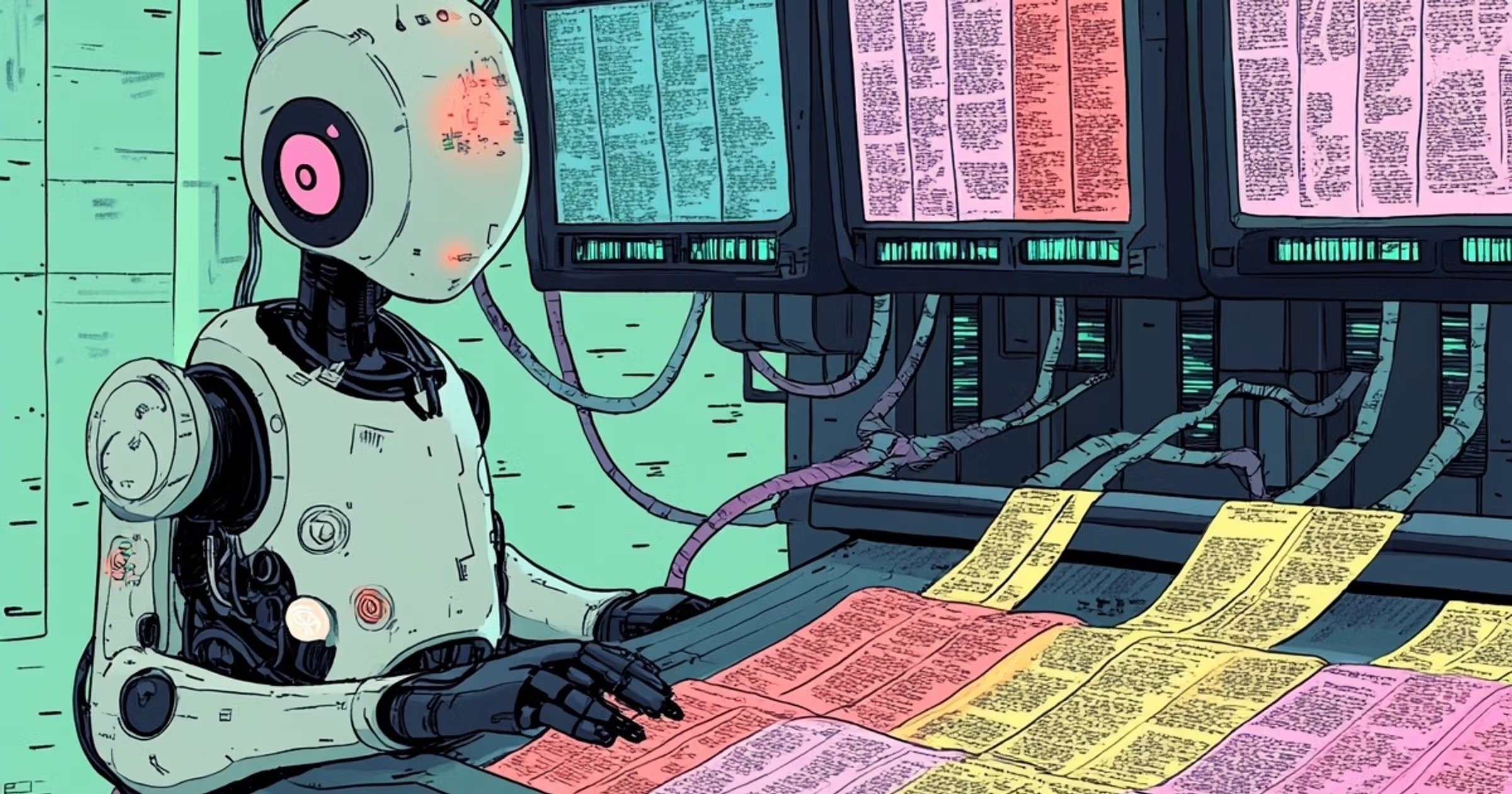
What happens when the amount of data needed to continue exponentially scaling the intelligence of AI models outpaces the capacity of us puny carbon based life forms to produce more text, video, and audio content. I wrote about it recently for the Stack Overflow blog:
One of the most striking things about today's generative AI models is the absolutely enormous amount of data that they train on. Meta wrote, for example, that its Llama 3 model was trained on 15 trillion tokens, which is equal to roughly 44 TERABYTES of disk space. In the case of large language models this usually means terabytes of text from the internet, although the newest generations of multimodal models also train on video, audio, and images.
The internet, like the oceans of planet Earth, has always been viewed as an inexhaustible resource. Not only is it enormous to begin with, but billions of users are adding fresh text, audio, images, and video every day. Recently, however, researchers have begun to examine the impact this data consumption is having.
“In a single year (2023-2024) there has been a rapid crescendo of data restrictions from web sources,” write the authors of a paper from the Data Provenance Initiative, a volunteer collective of AI researchers from around the world, including experts from schools like MIT and Harvard, and advisors from companies like Salesforce and Cohere. For some of the largest and most popular collections of open data typically used to train large AI models, as much as 45% has now been restricted. “If respected or enforced, these restrictions are rapidly biasing the diversity, freshness, and scaling laws for general-purpose AI systems.”
You can check out the full piece here.
There are now many examples, of course, of large AI labs and canny startups willing to pay human beings to sit at home all day, chatting with AI, generating fresh input by activating their cerebellums and typing the output into digital receptacles. One hopes that the fission of our chaotic emotional intelligence and Large Language Models can catalyze into something new for both sides.

Will we ever get to driverless cars
A future of driverless cars feels increasingly remote. Will a breakthrough come from tech, or society?
Back when I was a journalist at The Verge and a comms guy at DJI, the rise of autonomous vehicles, driverless cars or drones that carried people, seemed inevitable. I bought into the credo that my own children would never have to learn to drive.
But take a look at some recent pieces from my old colleague Andy Hawkins at The Verge and you get the sense that the driverless car industry is hitting a wall. Argo.AI, a extremely well funded started backed by Ford and VW is shutting down. Instead of pushing for fully remote vehicles, companies like Ford are putting more emphasis on advanced driver assist features that make some parts of driving, for example on the highway, feel like a fairly autonomous experience.
If you want to soak in some nostalgia from the heady days of 2017-2018, when driverless cars felt like a safe bet for the near future, read here. Or check out this feature length ode to Velodyne and the inventor of LIDAR, which I loved researching and writing. The tech is amazing, but the company’s dream of it’s sensors being a mainstream component on mass produced cars still feels like a distant dream.
For coders with internet access, an offline encyclopedia provides a lifeline
For the millions of coders and students who don’t have reliable internet access, Stack Overflow is working on an offline version of our community knowledge base that can be used anywhere.
After 3 years of work, I’m excited to announce the launch of the Overflow Offline Project.
There are coders and students across the world who can benefit from the enormous amount of knowledge our community has shared, but don't always have internet access to reach our platform online.
We're working with a great non-profit, Kiwix offline, to ensure those folks can tap into this virtual encyclopedia without an internet connection, that the data remains up-to-date, and that it's easy to read and search.
Overflow Offline is already being used by great organizations like Code4000, Bard Prison Initiative, Unlocked Labs, and The Last Mile to provide a resource to students learning in prisons where internet is not available.
Overflow Offline has also been used by scientific researchers like the folks at IceCube Labs, who are studying neutrinos at the South Pole, and have spotty internet most of the year.
It's also being utilized by folks like EduAir, who provide an offline version of Stack Overflow to help students who don't have affordable access to internet at school or at home.
We hope this is the beginning of a long term effort, and that we will be able to learn from our users and improve the data so it becomes easier to access and provides more value to an ever wider collection of people and organizations.
Check out our blog to learn more about the organizations involved and how you can help through donations or open source contributions. And a huge thanks to the many colleagues at Stack Overflow who helped make this project a reality!
Click Farm

Do you ever think about the word digital? It sounds modern, and it’s usage has exploded since the invention of the computer. But it’s actually quite an old term, from the Latin digitalis, or digitus, meaning finger or toe.
It was once used to refer to a number less than 10, a unit of measure you could count one your fingers, in other words.
Over the last few decades it has come to embody the relentless power, speed, and progress of technology. It’s usually contrasted with the physical or analog. People will say they prefer the warmth of a vinyl record to the sound of a digital music file.
The pandemic upended my reality, as it did for so many others. I used to live in Brooklyn and work in Manhattan. I was surrounded by concrete, metal, and glass. I had a small apartment and rode to work in an enclosed metal tube with strangers pressed in against my face.
Now I live on a rural road surrounded by grass and trees. The site where my house is located used to be a horse farm, and an orchard before that. There is still old manure composting in the barn. There are old apple trees that give fruit, decades after they were first planted.
Rabbit and deer graze on the clover in my back fields. Wild turkeys gather in the early morning to perform their mating rituals. I spend a lot o time working with my hands. I pick fruit and plant seeds. I plow soil and hunt game. I butcher meat and tan hides.
All the while, I stay connected to the digital realm. I relax in a hunting blind and make turkey calls. I broadcast the sound on Twitter spaces and add comments to a Google Doc. I walk my dog through the woods to forage mushrooms while listening to an edit of the latest podcast. I reply to Slack messages and update Wordpress while feeding chickens and collecting eggs.
My office isn’t going to reopen anytime soon, and even when it does, there will be no pressure to return on a regular basis. For knowledge workers like me, a new era has begun. It existed before the pandemic, but it wasn’t as common or accepted or robust.
I like this collision of two worlds, where you can work with atoms and bits, with your hands and your mind, with your reality and with the virtual, all at once. Digital has two very different meanings, and now it can encompass both of them at once.
Photo credit: Nenad Stojkovic
Up, Up, and Away
This week was my last as a journalist at The Verge. In my five and a half years with the publication, I’ve written more than 1,000 stories. Along the way, I got married, had a couple of kids, became a cyborg, walked through virtual realities, and travelled to the other side of our world. This has been the most rewarding, challenging, and inspiring job I’ve ever had, but I’m ready for a new adventure.
As I prepare to leave the world of journalism, I've thought a lot about something Nilay Patel, my terrific editor-in-chief, told me the first day we met. As journalists, he said, we should always remain skeptical, be critical when necessary, and never shy away from telling the truth. But a piece of our editorial mission at The Verge was also to peddle hope, to be excited about the future and what innovation might bring.
Over the years, I’ve found myself drawn to that simple mission, to stories about the ways in which new companies, technologies, and products are changing the world for the better. After a decade writing about the world as an outside observer, I’m interested in seeing what it’s like to help build a business from the inside. So I’m joining the communications team at DJI, the world’s leading manufacturer of consumer and commercial drones.
I first learned about drones at SXSW 2013, and from the beginning two things were clear. Drones were about to take the world by storm, and DJI, a company no one in my world had heard of, would stand out from the pack. Over the last four years it has separated itself from the competition, the first Chinese company to emerge as the global leader in a major consumer electronics category.
I spent the holidays reviewing everything I’ve published during my time here and was struck by just how much has changed in half a decade. Bitcoin had already been through some minor booms and busts when I first wrote about it for The Verge. At the time the value of Bitcoin in circulation was $1.5 billion, a sum that seemed massive, given how few people knew it existed, much less understood how it worked. My colleague Adrianne Jeffries took a group of us out to a bar that accepted Bitcoin and bought everyone a few rounds. The coins were worth $120 a piece at the time, and it seemed to us as though that would surely be the peak of the phenomenon.
We weren’t the only ones to miss that boat - predicting the future is hard. My first big feature for The Verge peeked into the lives of basement bio-hackers who believed we were on the cusp of combining our frail flesh with more easily upgradable machinery. Advances in brain-computer-interfaces from the world of medicine continue to produce incredible results, and robotic exoskeletons are proliferating in the workplace. But the last five years have shown that most people aren’t ready to wear a pair of smart glasses or spend much time inside a virtual reality headset, much less cut themselves open to put a chip inside.
What we have become is eternally connected and online, livestreaming our way through a world where hacks and tweets shape the geopolitical arena more than military might. Everyday life comes down to how you tune the algorithms and notifications around you, and to which buttons you push and why. It’s why we care so deeply about net neutrality, which in my time here was mortally wounded, miraculously reborn, and then felled once again. The fight seems far from over.
This will be my first time in five years not making the annual pilgrimage to the CES in Las Vegas, although just writing about it brings back that special odor: a mix of stale trailer, unwashed blogger, and endless carpeting. I went to CES for the first time unsure of what I should be covering. In an effort to generate some excitement, I tased myself with an iPhone case and got punched in the head. Over time, as I found my focus, I stopped hurting myself for views and started embarrassing myself instead.
As drones became my primary beat, CES became an annual review of just how fast things were changing. While the form factor of smartphones solidified, with modifications measured in millimeters, consumer drones evolved radically in size and shape with each new generation. They went from simply taking pictures to inspecting bridges, fighting fires, and delivering packages. They learned how to follow subjects and dodge obstacles. I'm convinced drones will become smarter, more autonomous and far more ubiquitous over the next decade, and I hope to play a part in making that happen.
This new job will be very different, I’m sure, but the key elements remain the same. How can I use storytelling to help explain the ways technology is changing the world so that people want to know more? While remaining realistic about the challenges innovation brings with it, I’m excited to use my new vantage point on the technology world to find ways I can make people hopeful about what the future will bring.